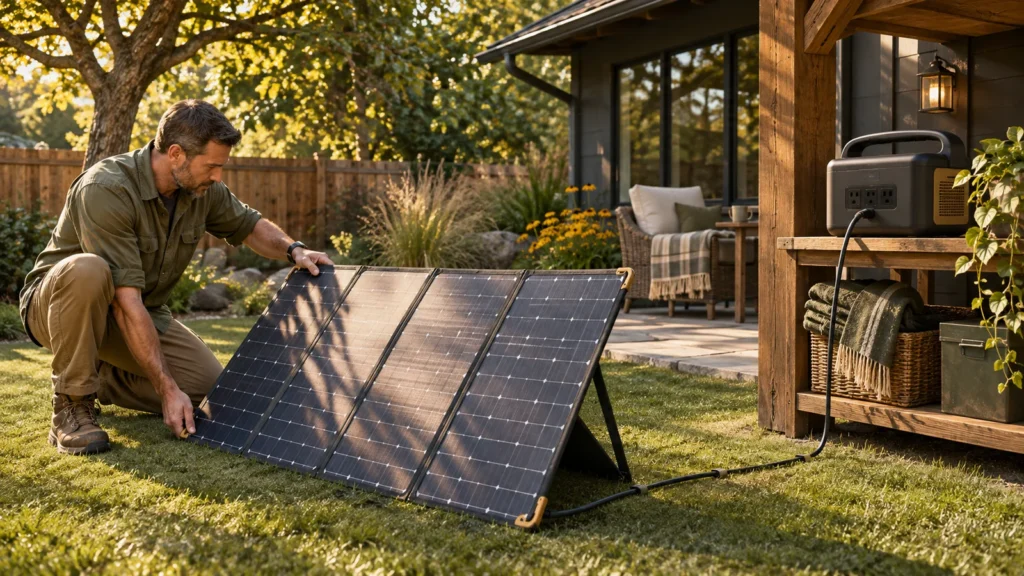
The phrase “solar generator” often describes a battery power station that can be charged by a compatible solar panel. The panel produces electricity when conditions allow; the battery stores some of it for later. Treat those as two linked functions rather than assuming one product creates continuous power whenever it is needed.
For an extended outage, the important comparison is between daily usable production and daily demand, with a reserve for poor conditions. A system that works during a sunny demonstration may not support the same tasks through cloud, shade, seasonal changes or equipment limits. Solar can expand options, but it does not remove the need for fallback decisions.
Start with the loads
List the devices you intend to support, their verified power requirements and the hours of use. Separate essential tasks from optional convenience. A plan for communication and selected lighting is different from a plan for refrigeration or temperature control.
Review whether direct compatible DC charging is available and appropriate, but do not improvise connections. The intended equipment's instructions govern. Medical support requires a provider-qualified arrangement; an ordinary portable system should not be assumed adequate for an essential device merely because its connector fits.
Distinguish panel rating from daily energy
A panel's watt rating describes power under specified test conditions. It is not a promise that the panel produces that amount every hour of daylight. Daily energy depends on the available sun, orientation, shade, weather, temperature and the actual system.
For an explicitly hypothetical calculation, 200 W × three equivalent peak-sun-hours × a chosen 0.70 system factor gives 420 Wh per day. The three hours and 0.70 factor are illustrative assumptions, not a forecast for your location or specifications of a named product. Change either input and the estimate changes.
Find local planning information
Use appropriate local solar-resource information and understand what the figures represent. Average seasonal conditions do not guarantee performance on a particular day. A long outage may coincide with smoke, storms or winter weather that makes an optimistic assumption especially weak.
Record the time period, location and limitations of any resource estimate used. If you have a portable setup, observe its behavior safely under several ordinary conditions and keep those observations separate from long-term guarantees. One clear afternoon is not a complete reliability study.
Verify the electrical match
Read the station's permitted solar-input voltage, current, connector, polarity and power limits, then compare them with the panel and any approved accessories. Similar-looking connectors do not establish compatibility. Do not connect unfamiliar panels in series or parallel based on a generic online diagram.
Work on fixed wiring, building circuits or roof installations belongs to qualified professionals under applicable requirements. A household guide is not an installation design. If the product documentation does not support the proposed arrangement, stop and obtain the appropriate guidance instead of relying on an adapter that happens to fit.
Plan the physical location
A panel needs a suitable place with useful light, secure support and a cable route that does not create a hazard. A battery may have different protection and temperature requirements from the panel. Do not leave a station in weather or heat exposure it is not designed to tolerate simply because the panel belongs outdoors.
Consider people, animals, access routes, wind and property rules. Avoid unsafe roof climbing or placing equipment where it obstructs an exit. Apartment dwellers may have limited lawful options; acknowledging that constraint is better than forcing an unsuitable installation.
Balance production, use and storage
Suppose the household's verified essential tasks require 300 Wh on a particular day, while a planning estimate gives 420 Wh of usable production under its stated assumptions. The apparent 120 Wh surplus must still be understood in context: charging limits, storage headroom and timing can prevent every theoretical watt-hour from being captured.
If the next day provides less than the load requires, stored energy covers some deficit until it is depleted. Record both the production scenario and the battery's usable reserve. Do not count the same stored energy again every morning as if it were new generation.
Plan for a poor-sun interval
Ask which loads can be reduced and which cannot. Identify a safe recharge alternative or a place to go before an essential service fails. A larger panel alone may not solve a prolonged period with little usable sun, and a larger battery alone does not create a renewable supply.
Choose an early action threshold rather than waiting for a zero-percent display. The threshold should reflect the actual task, the people involved and the time needed to obtain help or relocate. For medical or temperature-related needs, professional and official guidance take priority over a general energy calculation.
Use a documented operating routine
Keep the panel and station instructions together with the load list. Record who can set up the equipment safely, where it can be placed and what conditions require stopping. Inspect cables and connections as directed; do not continue operating damaged or wet equipment to protect an energy target.
Make charging and discharge observations at consistent times if useful. A log can reveal a system that is slowly losing ground despite sunny intervals. Explain uncertainty honestly: a percentage display and an estimated runtime are not the same as a measured guarantee of energy available for the next three months.
A practical comparison exercise
Compare two hypothetical plans for the same small load set. Plan A assumes clear weather every day and has little reserve. Plan B uses a more conservative production scenario, reduces optional loads and identifies a verified place to recharge or stay if conditions deteriorate.
The exercise is not a claim that one particular battery size is sufficient. It tests whether the household has recognized variability. Record the assumption most likely to fail and the action that follows. If you cannot name that action, the plan is still dependent on optimism rather than resilience.
Evaluate the charging location as a system
A suitable panel location needs sunlight, a stable mounting arrangement, safe cable routing and compatibility with the storage equipment. A sunny spot that blocks an exit or requires a cable across a wet walking route is not a complete solution.
Read the permitted input range and connector requirements for the exact power station and panel. Voltage, current, polarity and charging control matter. Do not assume products are compatible because their plugs can be joined with an adapter. Obtain manufacturer confirmation when the combination is unclear.
Consider where the battery itself may operate safely. The best panel location may not be an appropriate place to expose the power station to heat, rain or physical damage. Follow both devices' instructions and do not invent an enclosure that blocks required cooling.
Model a poor-sun period
Start with a clearly hypothetical daily essential load and compare several possible charging days. If the illustrative load is seventy watt-hours and one day's usable charging is only thirty, the reserve falls by forty watt-hours before any other changes. The next sunny day must cover both current use and any replenishment goal.
This arithmetic does not forecast weather or determine real panel output. It exposes the dependency on repeated charging opportunity. Use local conditions and actual supported observations where available rather than multiplying a panel's rated power by all daylight hours.
Write the action for an extended shortfall: reduce optional demand, obtain a verified supported charging opportunity or relocate when essential needs cannot be maintained. Do not ration necessary medical support to preserve a preferred plan.
Keep the equipment maintained according to its instructions and inspect accessible connections for damage without opening energized components. A portable solar arrangement can support useful limited tasks, but its contribution should be described in measured or clearly assumed energy terms rather than the vague label “solar generator.”
Solar-readiness check
Verify loads, local resource assumptions, exact electrical compatibility, permitted location, safe handling, usable battery reserve and a poor-weather fallback. Keep the calculations readable enough that another household member can explain them. Solar equipment is most useful when it supports a modest, well-understood task list and does not become a reason to remain where conditions are unsafe.
Sources and safety references
Reviewed November 2026. Planning examples use stated assumptions; they are not product tests or survival guarantees. Follow current local instructions and qualified guidance for individual medical, building and utility decisions.