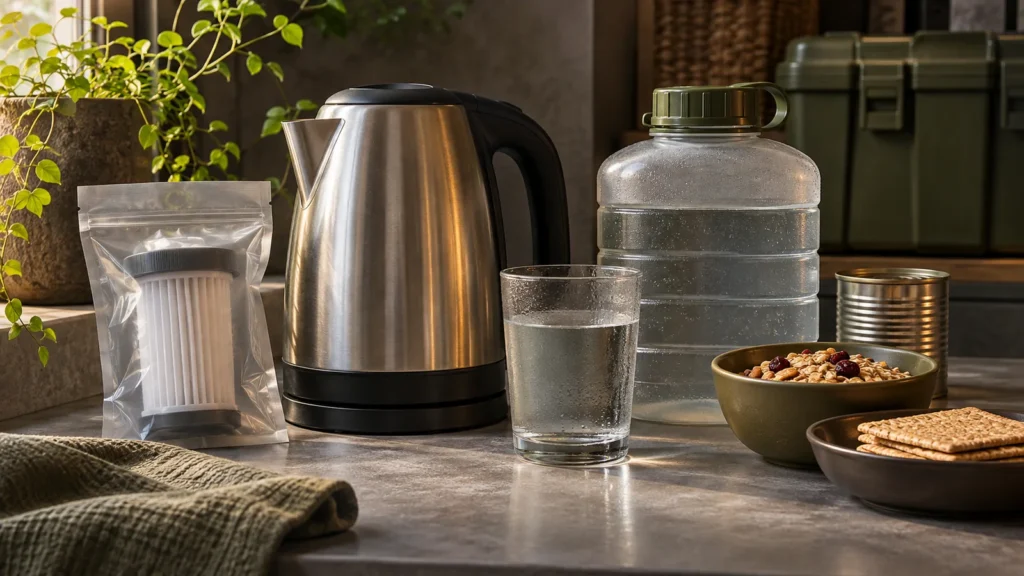
Boiling, filtration and chemical disinfection do different jobs. They are not interchangeable promises that unknown water becomes safe. The first decision is whether the source is suitable for household treatment at all; the second is which method addresses the relevant hazard.
Follow local advisories. If water may contain fuel, toxic chemicals or another contamination that ordinary household methods cannot address, use a confirmed alternative source. Do not boil suspicious chemical water indoors or keep adding bleach in the hope of solving the wrong problem. When reliable source assessment is unavailable, obtaining safe bottled water or relocating may be the more protective choice.
Read the advisory before choosing equipment
A boil-water advisory is not the same as a do-not-drink or do-not-use instruction. The reason for the warning matters. Record the issuing authority, affected area, permitted uses, issue time and any instructions specific to the event. Do not use an old screenshot as proof that the current supply is safe.
Ask about cooking, drinking, tooth brushing, infant feeding, food-contact cleaning and care needs separately when guidance is unclear. People with particular health vulnerabilities may need additional professional advice. A general article cannot replace instructions for a specific contamination event.
Prepare a clean handling route
Separate untreated water, treatment equipment and containers ready for safe storage. Keep hands and contact surfaces clean. Do not pour treated water into a vessel that was just used for untreated water without appropriate cleaning and sanitizing.
If water is cloudy, CDC advises allowing it to settle and filtering it through a clean cloth, paper towel or coffee filter before the relevant treatment. Removing visible particles is preparation; it does not establish microbiological safety. Mark a container's status so a helpful person does not accidentally serve water still awaiting treatment.
Boil when the method is appropriate
CDC's emergency guidance calls for bringing clear water to a rolling boil for one minute, or three minutes above 6,500 feet. Allow it to cool before handling and place it in clean, sanitized containers with tight covers. Protect people from burns and keep children away from hot vessels.
Boiling requires a safe heat source and enough fuel or electricity. It does not remove every chemical and can be an unsuitable response to some contaminants. If your cooking method itself introduces carbon monoxide or fire risk, the treatment plan has created another emergency. Never bring an outdoor camping stove or generator indoors to make boiling convenient.
Understand what a filter can actually do
Read the exact product's documented treatment claims, maintenance instructions, throughput limits and replacement requirements. Do not infer performance from the word “survival,” a dark filter element or a claim about taste. A device that improves taste is not automatically an emergency pathogen treatment system.
Portable filters vary in what they remove. CDC notes that many do not remove all relevant bacteria or viruses, and filtered water may need an appropriate additional treatment. The contaminant and the product's verified capabilities must match. Do not assume that several unsuitable devices in a row provide complete protection.
Use chemical disinfection only with the right instructions
For emergency household bleach treatment, CDC provides a concentration-specific table. Its guidance for clear water and plain, unscented household bleach containing 5%–9% sodium hypochlorite uses eight drops per US gallon, followed by mixing and a wait of at least thirty minutes. Its table specifies doubling the listed amount for cloudy, murky, colored or very cold water. Confirm the current instructions and the actual bleach label before any use.
Do not use scented, splashless or additive-containing products, an unknown concentration, an unmarked container or a guessed capful. Do not mix bleach with other cleaners. If you cannot establish the product and correct measurement, select an appropriate alternative method or safe source instead of improvising. Container-sanitizing recipes are not drinking-water doses.
Know the biological limits
Different methods act differently against organisms. Ordinary chlorine treatment is not a universal solution to every parasite, and treatment products can require particular contact times and conditions. Follow product-specific instructions and CDC guidance rather than substituting the contact time from a different product.
For a household member with an immune condition or another special need, obtain care-team advice about suitable water. Do not interpret an ordinary emergency recipe as individualized medical clearance. Seek another verified source when treatment cannot be performed reliably under the available conditions.
Keep a batch record
Write the source, volume, method, product concentration where relevant, measurement, start time, required waiting time and clean storage container used. A timer may be helpful, but the record must remain readable if the phone battery fails. Do not leave a partly treated vessel where someone could mistake it for ready drinking water.
For repeated batches, use the same organized process while checking each batch's relevant conditions. Avoid scaling a tiny dropper recipe to very large volumes without appropriate instructions and accurate measuring equipment. Measurement errors become consequential when everyone assumes that a large tank has already been made safe.
A planning example: the filter is only one component
A household has a portable filter but no documentation for virus removal, no safe collection container and no plan for storage after treatment. The missing components cannot be solved by buying more filter cartridges alone.
Before relying on the system, they identify the exact model, check its documented limits, select a suitable source and obtain current advice on any necessary additional treatment. They also establish a clean handling route and a fallback source. The exercise improves a process; it does not prove that the household can safely treat any water encountered during ninety days.
Avoid false shortcuts
Clear appearance, normal taste and lack of odor do not prove safety. A photograph of someone drinking from a filtered stream is not a test report. Boiling longer is not a universal chemical-removal method. Adding disinfectant by eye is not a dependable substitute for instructions.
Treat household water work as a task that can fail. If the source, method, measurement, contact time or storage cannot be verified, stop and use an appropriate confirmed alternative. Preserve enough safe water to support the time needed to obtain help or leave, rather than waiting for the last container before reconsidering the plan.
Read an advisory before selecting a treatment
Create a simple decision record: the issuing authority, affected area, date, suspected hazard and permitted uses. A boil-water instruction is not the same as a do-not-use instruction. If information is unclear, use a confirmed safe source while contacting the responsible authority.
Do not assume that water becomes suitable for every task after one household treatment. Drinking, infant feeding, wound care and specialized medical uses may have distinct requirements. Follow the responsible professional and current advisory for those uses.
Keep the current CDC table or official instructions available offline, but verify that the product and situation match before applying them. A recipe for cleaning a container, disinfecting a surface or treating water is not interchangeable. Label the purpose clearly so a tired person cannot confuse instructions.
Test comprehension without handling chemicals
During normal conditions, give another adult a printed hypothetical advisory and an unopened product label. Ask them to identify the missing information, appropriate authority and reason to choose bottled water or another confirmed source. Do not actually dose drinking water as a demonstration unless the situation and approved instructions require it.
For a filter, locate the specific contaminant claims, maintenance needs and replacement instructions. Ask what it does not address. A device described as improving taste may not be a pathogen-treatment device. A filter capable of reducing one hazard may leave another unchanged.
For boiling, consider whether the household has a safe heating method, suitable container, cooling time and clean storage. The process must be physically workable without indoor combustion or burn hazards. A correct instruction still needs a safe setting.
Write a stopping rule: unknown chemical contamination, an incompatible product, unclear concentration or conflicting local advice means stop improvising and obtain a confirmed safe supply or professional guidance. The purpose of the exercise is to recognize limits. Successful preparedness includes deciding not to use a treatment when its suitability has not been established.
Before the next batch
Check the advisory, source suitability, equipment instructions, clean containers, measurement and completion record. Keep fuel and chemical supplies away from food and drinking-water storage. Plan who can perform the process safely if the usual organizer is absent. Competence here means respecting the method's limits, not confidence in an improvised technique.
Sources and safety references
Reviewed November 2026. Planning examples use stated assumptions; they are not product tests or survival guarantees. Follow current local instructions and qualified guidance for individual medical, building and utility decisions.