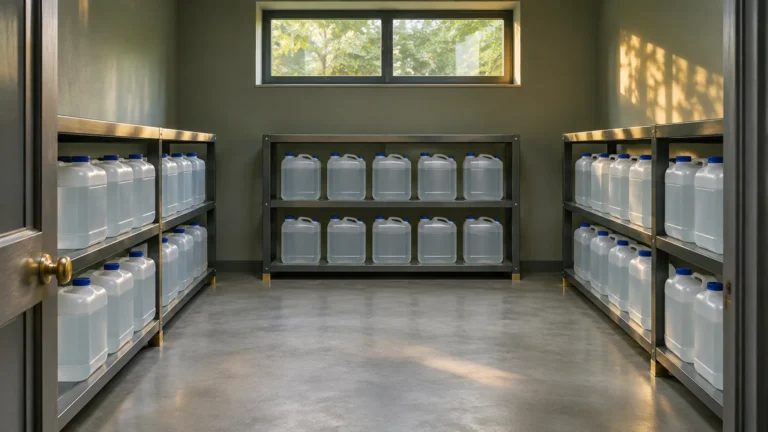
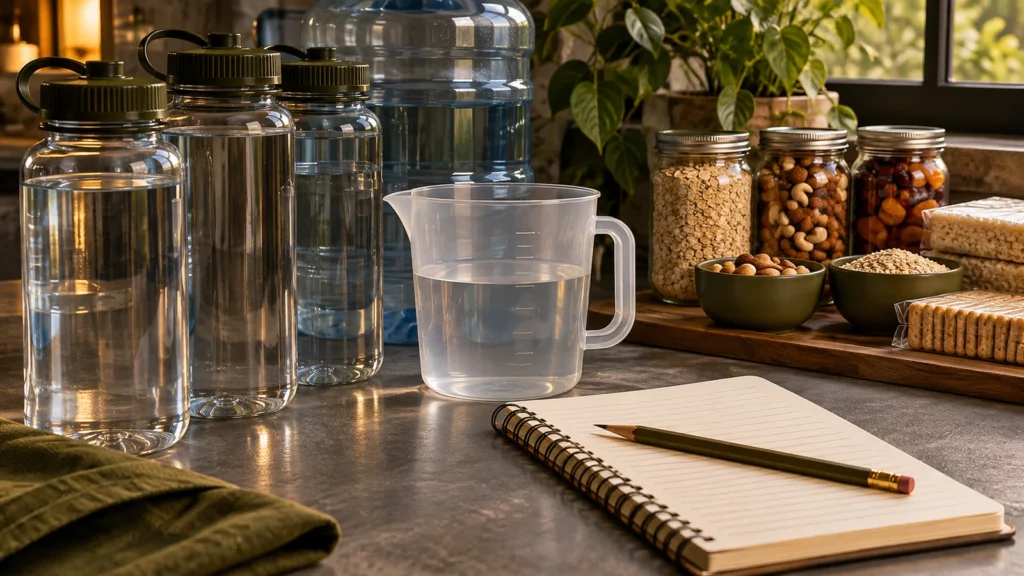
A ninety-day water total is easy to multiply and difficult to make operational. The arithmetic can expose how much a household depends on water delivery, storage space, physical carrying capacity and functioning sanitation. It should not be used to prescribe how little someone is allowed to drink.
Start with people and days, then separate stored supply from a replenishment plan. CDC recommends at least one gallon per person per day for an emergency supply, initially covering three days and, where possible, extending storage toward two weeks. Applying a ninety-day horizon is this series' planning exercise, not a claim that CDC requires every household to stock ninety days at home.
Define the unit and the scope
Use US gallons consistently if that is what your containers show. Do not switch between liters, imperial gallons and US gallons midway through a calculation. Write the unit beside every inventory figure, and record usable contents rather than container capacity when a vessel is not full.
The basic planning expression is people × days × gallons per person per day. This gives a volume under the assumption entered. It does not prove that the result covers every task, every person or every climate. Additional needs can include pets, illness, pregnancy, hotter conditions, food preparation and a separately planned hygiene or sanitation allowance.
Calculate a clear baseline
For four people over ninety days at an assumed one gallon each per day, the baseline is 4 × 90 × 1 = 360 US gallons. For the same people over fourteen days, it is 56 gallons. These different totals help distinguish immediate storage from the larger continuity problem.
Suppose the household has 42 usable gallons stored. At the illustrative four-gallon daily baseline, that is 42 ÷ 4 = 10.5 days. The arithmetic does not mean the family should ration themselves to make the supply reach day eleven. It identifies a limit that requires replenishment or relocation planning before the supply becomes critical.
Do not count one gallon twice
Create separate lines for drinking and food preparation, additional household needs, pets and sanitation. If your chosen per-person allowance already includes a particular use, explain that instead of adding the same use again. If it does not, include a separate line rather than pretending it is covered.
For example, adding an explicitly chosen household allowance of two gallons per day to a four-gallon baseline makes six gallons per day. Ninety days then means 540 gallons, not 360. The additional two gallons is a hypothetical planning input, not a professional recommendation that every household can meet its hygiene needs with that quantity.
Measure ordinary tasks safely
Observe how much water is used for one meal's preparation or a particular cleaning task while normal service remains available. Record what was included. A pot used for boiling food may also require water for washing; a meal based on ready-to-eat food may have a different demand.
Do not simulate scarcity by withholding drinking water, changing a medical regimen or making hygiene unsafe. A sample observation is useful evidence, but weather, illness and additional people can change the result. Keep observed figures separate from assumptions so a reader of your plan can see the uncertainty.
Convert quantities into manageable containers
Compare the total with the containers people can lift, the storage location and the route between them. A five-gallon container may be manageable for one person and unsuitable for another. A large fixed tank introduces different concerns from small bottles: access, maintenance, contamination control and the ability to draw water safely.
Water is heavy. Do not assume a closet, raised platform or upper floor can support a large concentrated load merely because the containers fit. Obtain qualified advice for substantial storage loads and follow property restrictions. Clear exits and accessibility remain requirements; supplies should not turn a hallway into an obstacle course.
Separate capacity from dependable availability
Your inventory should distinguish sealed safe drinking water, water awaiting treatment, water reserved for other purposes and an expected future delivery. Only the first category is immediately ready for the uses stated. A bathtub or outdoor collection barrel is not equivalent to commercially bottled drinking water.
Expected replenishment belongs in a separate schedule with a source, confirmation method, transport arrangement and fallback. Do not add unconfirmed deliveries to the stored total. A distribution point may change location or hours, and you may not be able to carry the quantity you originally assumed.
Test a realistic renewal interval
If the household uses an illustrative six gallons daily and can reliably obtain 30 usable gallons per trip, that delivery covers five days under those assumptions. The plan must also account for the trip itself, carrying capacity, safe containers and information confirming that the source remains available.
The calculation becomes more useful when you stress it: What if a trip is delayed? What if a caregiver cannot drive? What if local guidance says the normal source is unsafe? A reserve that keeps the household from making a desperate last-minute trip has a different purpose from a promise of complete ninety-day independence.
Use the hub calculator responsibly
The water calculator in the educational hub accepts people, days, a user-chosen per-person daily allowance and an additional household daily allowance. It displays the formula, total gallons and the distinction between assumptions and verified needs. Calculations remain in the browser; you do not need to enter names, medical conditions or financial details.
Use one scenario for the household currently present and another for likely guests or caregivers. Keep the results as planning comparisons. Do not interpret a calculated total as a medical recommendation, a guarantee of safe storage or proof that your home remains suitable during the outage.
Set a water-related departure threshold
Identify how you will act if safe drinking water or necessary sanitation can no longer be maintained. That decision should happen before the final container is empty. Seek official distribution information and assistance early, especially when transport, mobility or health needs make replacement difficult.
Contaminated water changes the problem. Boiling or adding disinfectant does not make water containing fuel or other harmful chemicals safe. Follow the applicable local advisory, obtain another suitable source and use the treatment guide for its limited purpose rather than assuming every emergency has the same solution.
Separate drinking, preparation and other uses
Create rows for drinking and basic food preparation, any individually required care uses, pets and other planned tasks. Avoid counting the same water twice. If a meal uses one quart from the drinking reserve, it cannot also remain available for a later drink.
Use one volume system throughout the table. A US gallon is not the same as every container sold under a similar name internationally. Read the actual capacity and convert consistently when needed. Do not estimate usable quantity from a photograph of a container.
For a hypothetical two-person household using a planning starting point of one gallon per person per day, ninety days produces 180 gallons before any additional needs. That arithmetic is not a statement that the amount is sufficient for every climate or person. Record the assumptions beside the answer so another adult can understand and revise them.
Work backward from a realistic storage limit
If a household can safely store only a smaller quantity, do not silently lower its estimated need. Record the gap and develop a verified replenishment or relocation arrangement. Structural capacity, lifting, space, temperature and contamination control all constrain storage.
Suppose the household has twenty-four usable gallons and its current combined planning rate is three gallons per day. The simplified coverage is eight days. If conditions change and the rate becomes four gallons, coverage becomes six days. The inventory did not change; the assumption did.
Set the next action before the reserve is exhausted. The threshold depends on reliable lead time, transportation and actual needs. It should not be a universal percentage copied from another household.
Use the hub calculator as an arithmetic aid, then review the result against CDC guidance and individual requirements. It cannot determine medical adequacy or water safety. Keep the source and treatment question separate from the volume question, and never use a calculator result as a reason to deny needed water.
Calculation check
– Four people × ninety days × one gallon = 360 gallons. – Four people × fourteen days × one gallon = 56 gallons. – Forty-two gallons ÷ four gallons daily = 10.5 days under the baseline. – Six gallons daily × ninety days = 540 gallons. – Thirty gallons per verified trip ÷ six gallons daily = five days between equivalent replenishments.
A strong water budget makes uncertainty visible. Record the quantities, uses, source status, carrying limits and action triggers, then revisit them as conditions change. The objective is dependable safe access, not an impressive number detached from the household that must use it.
Sources and safety references
Reviewed November 2026. Planning examples use stated assumptions; they are not product tests or survival guarantees. Follow current local instructions and qualified guidance for individual medical, building and utility decisions.